California Goes from a Surplus Budget Of $97 Billion in 2022 to Major Downturn
Legislative Analyst Office Warns State Faces An $18-$35 billion Deficit In 2027-28
Written by
SACRAMENTO–California’s heavy reliance on wealthy earners’ income tax and capital gains caused a record $97.5 billion surplus in 2022 during an economic boom which was then followed by an estimated $56 billion deficit over the next two fiscal years. Now the Legislative Analyst Office is warning that the State faces an $18-$35 billion deficit by fiscal year 2027-28.

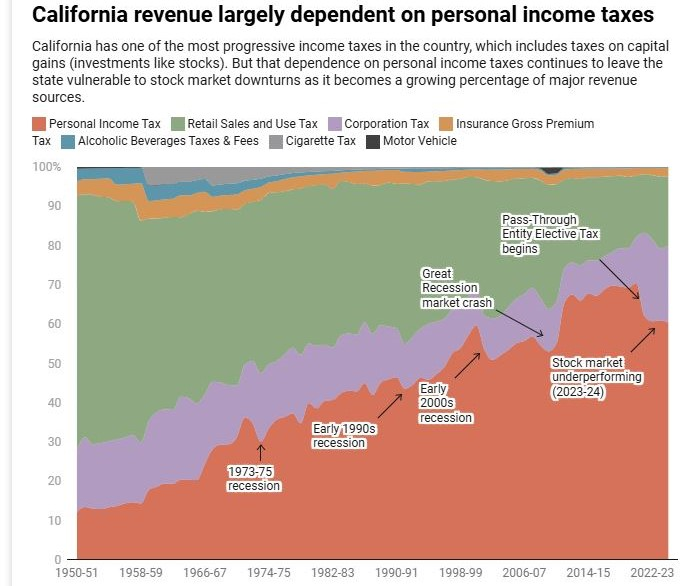
In two years, California had a revenue swing of almost $155 billion dollars. California collects taxes to fund state programs. The state’s major revenue sources have shifted from retail sales and use taxes to personal income taxes. Because of California’s progressive income tax, the state’s top earners pay at a higher rate and provide a bulk of that tax revenue. The top one percent wage earners pay the most.

California has a flat 8.84 percent tax on the gross taxable income of businesses and corporations doing business in California, excluding some types of business such as sole proprietors and partnerships and financial institutions. While the current statewide sales and use tax rate is 7.25 percent, that rate can be higher depending on additional taxes levied by cities and counties.
To put together a California budget according to California Matters, legislators pay attention to the end-of-the-year balance–the difference between expenses and available tax revenue and the previous year’s ending cash on hand.
The average ending balance from 2006 through 2019-20 fiscal year was a surplus of about $2.8 billion; for 2020 through 2022-23 it was more than $37.5 billion.

In 1979, voters approved a limit on how much money the state can spend each year–beyond how much is in its bank account. Proposition 4 created the state’s spending limit, sometimes called the “Gann Limit” which says that if the state’s tax revenue increases too quickly for two consecutive years, the government has to either change tax rates, reduce spending or give taxpayers a rebate. The check-cutting isn’t triggered often, but it was the reason thousands of California families making as much as $75,000 a year got a Golden State Stimulus check in 2022 so that the state wouldn’t exceed the Gann Limit in 2020-21 and 2021-22 fiscal years.
The state for three years used “temporary fixes” such as internal borrowing, spending down reserves and suspending tax credit to plug the multibillion-dollar budget holes, but now it’s “critical” for state lawmakers to reduce spending, raise revenues, or both, the legislative analyst has warned.
“California’s budget is undeniably less prepared for downturns,” the analysts noted in their report. While all signs point to high uncertainty and low consumer confidence in the state economy, tech companies’ investment in Artificial Intelligence (AI) has propelled the stock market to a “record highs” and boasted tech workers’ income–in a November, 2025 report issued by California Matters.
The widening budget gap will most likely undercut the legacy of Gov. Gavin Newsom as he will likely be forced to make tough budget choices in his last year as governor. It also means that for the fourth year in a row in his tenure, California is projected to have a deficit despite revenue growth.
President Donald J. Trump’s budget bill is expected to kick millions of Californians off Medi-Cal, hike health care premiums and shift much of the cost for programs such as food stamps onto the state according to the Legislative Analyst Office which projects the added cost of the federal cuts to health care will grow to $5 billion annually by fiscal year 2029-30. California also stands to lose hundreds of millions of dollars in funding for permanent housing under new policies. The loss of federal funding puts more pressure on the state to to step in with financial assistance in releasing more homelessness dollars to cities and counties.
The Trump administration and Congressional Republicans have pushed through sweeping cuts to everything, from transportation dollars and health care funding to Supplemental Nutrition Assistance (SNAP). Billions in child care and social services funding over claims of fraud have drained California’s piggy bank.
Gov. Newsom last January proposed zero dollars for the Homeless Housing, Assistance and Prevention program, the main source of homelessness funding for local governments. The Legislature later successfully negotiated a $500 million investment–half what it used to be–and delayed the funds until this year with virtually no guarantee they will continue.
California’s Democratic leaders scrambled to plug a $12 billion budget hole in fiscal year 2025-26, relying on internal borrowing, dipping into state reserves and halting new Medi-Cal enrollment.
In Gov. Newsom’s Jan. 8 State of the State Address he postured himself as a presidential candidate in 2028 aiming to reassure cash-stripped Californians that he’s leaving the state in tiptop shape in his final year in office.
“Californians see the lack of results every day,” said Republican Leader Brian Jones of San Diego. “Year after year, his (Gov. Newsom’s) policies have pushed opportunity out of state while driving the cost of living to ever new heights for working families.”
California’s unemployment rate was the highest in the nation as of September, as everyday residents feel the pinch, from high prices on food, housing and gasoline driven by a mix of federal and state policies.
Lawmakers Response:
- Assembly Budget Chair Jesse Gabriel, D-46, Encino: We remain “committed to crafting a responsible budget that prioritizes essential services, uplifts working families and protects our most vulnerable communities.”
- Sen. Roger Niello, R-6, Roseville, Vice Chair of Senate Budget Committee: We have “unstoppable spending problems. The state must assess the effectiveness and sustainability of the programs that were created during the surplus and make necessary corrections.”
CaliRedNews.com is an online news platform focused on Making California Red by the 2026 elections through reaching Gen Z (ages 13-28), Hispanics, and Christians with biblical traditional values and their pastors. CaliRed News reports on political, business, community, nonprofit, and church news. Free subscriptions are available at https://substack.com/@calirednews or CaliRedNews.com.
Mike Hernandez is co-founder of the Citizens Journal–Ventura County’s online news service and writes for CitizensJournal.net and MountainTopMedia.com. He is a former Southern California daily newspaper journalist and religion and news editor, writer of “Prayer Over News Daily” and edits the weekly “Stories Speak Volumes” and other columns. Mr. Hernandez mentors citizen journalists and can be contacted on his website.