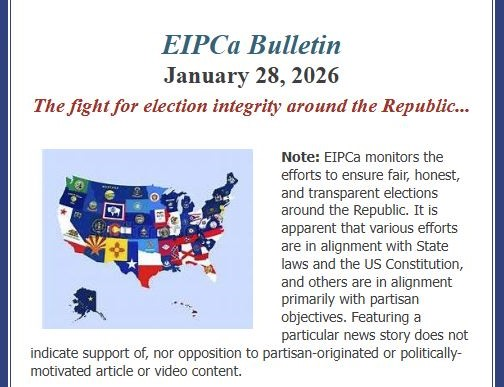
Advocates For Faith and Freedom and Election Integrity Project Ca Propose
Comprehensive Federal Election Integrity Legislation for All States
Written by Mike Hernandez
MURRIETA, CA–Advocates For Faith and Freedom: a non-profit law firm dedicated to protecting election integrity, religious liberty in the courts, free speech, parental rights and the rights of children along with Election Integrity Project California: a non-profit committed to defending the civil rights of U.S. citizens to fully participate in the election process under Federal and state law–have joined together to seek comprehensive federal election integrity legislation for all states.
(Editor’s Note: Readers can read the January 2026 Advocates For Faith and Freedom newsletter at https://faith-freedom.com/newsletter/january-newsletter-2026
about two cases before the U.S. Supreme Court on: whether biological males may compete in girl’s sports and another case on whether the government can impose fines on Calvary Chapel San Jose and Pastor Mike McClue for the ‘crime’ of gathering to worship. Readers can also read the Jan. 28 EIPCa newsletter which reports on election news across the nation at: https://www.eip-ca.com/newsletter/bulletin01282026.html.)
Executive Summary of Proposals for Congressional Action Necessary to Preserve and Restore Election Integrity Across the Nation (Pages 2-3)
This proposal is ambitious in that it addresses the many election laws that, together and synergistically, create a system that can be manipulated. It is our expectation that the expanded explanation of each issue will lead to Congress’s putting in place an electoral system that can be trusted by all citizens.
1. Proposal. Congress must pass a law that requires a prospective voter to provide photo verification that includes proof of citizenship, to register and to vote. To ensure that the law does not have a discriminatory or overly burdensome effect, Congress should provide assistance, free of charge, for people to obtain the birth certificates or other records necessary to obtain a voting card during the legitimate period when registration takes place.
2. Proposal. Congress must pass a law limiting the ability to vote-by-mail to a limited number of categories based on actual need. These can include those medically unable to get to a polling station, those not presently in the country, or other good faith reasons for not being able to vote at a polling place.
3. Proposal. Congress must pass a law that prohibits large scale ballot harvesting and undocumented chains of custody. When voters have valid reasons to vote by mail but cannot deliver their ballots, the laws should allow individuals within specified relationships to the voter, such as family members, close friends, or guardians to deliver the ballot for them. Likewise, the law should require proper security measures, such as requiring the carrier to sign the envelope in a manner that mimics chain of custody requirements typically required of a ballot.
4. Proposal. Congress must pass a law that prohibits States from allowing for same day registration and requires that registration deadlines provide States with reasonable and adequate time and opportunity to audit all registrations.
5. Proposal. Congress must pass a law clarifying that Election Day is the day on which all ballots must be cast and able to be counted, meaning that they must be received by Election Day in order to be counted.
6. Proposal. Congress must update NVRA and HAVA to ensure that their purposes can be met. This includes creating a federal database for States to use to remove from their lists of voters those who are not eligible to vote in that State and allow states a quicker means of removing ineligible voters.
7. Proposal. Congress must prohibit electoral systems that are structurally antidemocratic, confusing, and otherwise unreliable such as the Top-Two Primary and Rank Choice Voting.
In brief, these are EIPCa’s proposals
- Increase transparency of the entire election process;
- Require proof of citizenship to register to vote whether the voter lives in the country or overseas;
- Require Government-issued Photo Voter ID to register to vote, apply for and submit absentee/mail-in ballots, vote in person, or vote from overseas;
- Resolve the inconsistencies regarding voting from overseas;
- Update National Voter Registration Act of NVRA:
- Specifically limit states’ responsibility only to facilitating voter registration and specifically prohibit expansion of that responsibility;
- Prohibit states from making voter registration mandatory with DMV (or other agency) interaction;
- Include in an update of section 7 the requirement for proof of citizenship before providing a voter registration application, and reflect that mandate in an updated federal registration form;
- Make it easier and mandatory for states to remove inactive or ineligible registrations in a timely fashion in order to maintain accurate voter rolls;
- Update HAVA to include consequences for noncompliance “teeth” into its mandates to ensure compliance and monitor proper use of federal funds by state elections officials, particularly for proper training of poll workers and ballot processors.
- Create a federally managed program, such as a merged voter database of all 50 states, with citizen oversight to ensure no voter is able to be registered or to vote in more than one state or vote while ineligible.
- Prohibit Top-Two (jungle) primaries and Rank-Choice voting
- Limit the number of days of walk-in early voting to a maximum of seven days before Election Day.
- Eliminate no-excuse voting by mail.
- Prohibit most election technology and return to in-person voting with paper ballots and supervised hand-counting at the precinct level.
- Protect the security of the paper ballot by requiring a water mark that cannot be replicated, making it impossible to reproduce extra paper ballots.
- Prohibit “Same Day” registration.
California Election Model (Page 16-25)
Since 1998, California legislators and local elections officials have progressively implemented laws, regulations and procedures that severely diminish election integrity in the state of California, as reflected in EIPCa’s documents “The Golden State Agenda: California’s Legislative Blueprint for the Destruction of Election Integrity” and “All Paths Lead to the Golden State Agenda.”
These documents present a chronological listing, explanation and commentary of the laws with the most impact on election integrity that have been passed in California in the last 25+ years. Combined, these laws create what is now the California Model.
Since the 2012 Primary, EIPCa has trained over 20,000 volunteers to observe the election process in 43 out of 58 counties. EIPCa observers are trained in state and local election procedures, in how to ask elections officials lawful questions about the procedures, and writing and submitting to EIPCa Incident Reports signed under penalty of perjury.
Election Integrity Project®California (EIPCa) has amassed 14 years’ worth of evidence of the negative impact of these “California Model” laws and regulations on the integrity and validity of California’s electoral process.
Since January 2012, following its first statewide observation of the election process and research of the voter rolls, EIPCa has advocated for the citizens of California to have an electoral system that cannot be manipulated, and for the provable assurance that only lawfully cast votes are accurately counted.
As the state with the highest population, California has the highest number of electoral votes, boasting 10% of the total. Though only 1 of the 50 states, California elects 12% of the members of the House of Representatives; Texas, the state with the next highest number, elects 8%, while New York and Florida are next at 6%.
If California’s elections are manipulated, or inaccurate due to incompetence or general chaos caused by laws and procedures that do not protect voters’ constitutional guarantees, every resident of the U.S. suffers the consequences. Decisions made by potentially wrongly elected leaders diverts the will of the people in the remaining 49 states.
It is imperative that the federal government weigh the philosophy of states’ rights in electoral matters against the undue impact of California-style election laws. The “unintended” consequences of these laws deprive all Americans of their civil and constitutional right of self-governance.
True to the common maxim, what happens in California does not stay in California. Many states have begun to adopt California-style election laws to implement the California agenda as laid out in the “Future of California Elections,” a document created by a coalition of well-known organizations such as the ACLU and Common Cause.
The “California model” is based upon a re-imagining of the election system. The tenets of this agenda often do not align with the U.S. Constitution or federal law. These efforts are led in part by The Future of California Elections Organization.
Future of CA Elections website:
The Future of California Elections Network participants work to advance election policies and practices that ensure access to our democracy for all voters regardless of demographics, including race/ethnicity, disability, language, age, sexual orientation, gender and gender identity, socioeconomic status, geography, political preference, or religion. Furthermore, the Network holds itself accountable to ensuring full diversity, equity, and inclusion in its own structure and activities.
The threats to election integrity in the “California model” as documented by EIPCa include:
- Universal mailing of ballots to every registrant without proper voter roll maintenance;
- A 60-day election season, 37 of voting (including late ballot arrival) and 60 days of ballot processing;
- Mandatory registration by the DMV (often creating duplicates and illegal registrations);
- Acceptance of voted ballots 7 days after Election Day with no definitive proof they were marked on or before Election Day;
- Indiscriminate and unmonitored ballot harvesting;
- Same day registration and voting with inadequate follow-up to determine voters’ eligibility before counting those votes;
- Unstaffed and unmonitored drop boxes emptied only every 96 hours;
- Ballot “curing” up to 27 days after Election Day; and so much more.
The deleterious effects of the “California Model” have risen to the surface in recent years through California’s Voters Choice Act. The Act has several problematic mandates:
- Counties implementing the Act are required to mail ALL “active voters” a ballot, encouraging universal vote by mail;
- Any voter in the county may vote at any Vote Center in the county; precinct polls no longer exist;
- Vote Centers must be open 10 days prior to Election Day, and on Election Day. This has resulted in colossal waste of money on:
- venue rent;
- stipends to workers to staff 11-day Vote Centers that see single-digit numbers of voters in the first 8-9 days of operation;
- up to 5 to 10 full-day (8-hour) training sessions for poll workers due to the increased complexity of the voting process.
The Voters Choice Act has distanced citizens from their own electoral process. Where before citizens could serve as poll workers by donating 2 to 4 hours on a given day to be trained, and then 13 to 15 hours on Election Day to exercise a Civic Responsibility, now workers in some counties must give 5 days for training, one day for set-up, one day for break down and 11 days for staffing the polls. Responsible citizens with jobs and families are greatly inhibited from participating, as are the 16 and 17-year-old students who used to volunteer at the polls as tech assistants and bilingual aides.
In the lead up to the 2020 election, California and other states took advantage of people’s confusion and heightened fears of COVID to implement election procedures that would never have passed muster at any other time.
- California implemented an urgency legislation, AB 860, mandating that all “active” voters be mailed a vote by mail ballot, requested or not. That momentum led to the legislature’s move to make that mandate permanent with the passing of AB 37 and SB 29 in 2021.
- Also in California, certain circumstances allowed for “emergency regulations” implemented without proper procedure or public input.
- In 2016, the California legislature had passed AB 1970, mandating in part: “The Secretary of State shall promulgate regulations establishing guidelines for county elections officials relating to the processing of vote by mail ballots.”54 But by the middle of 2020, with a major presidential election looming, that statutory obligation had still not been accomplished.
- On July 17, 2020, a coalition of individuals and organizations involved in the aforementioned “Future of California Elections” filed with the California Secretary of State a letter entitled “Request for the Secretary of State to Promulgate Emergency Regulations in Accordance with AB 1970.”
- Responding to that pressure to fulfill the obligations of AB 1970, the Secretary drafted the new regulations, adopting recommendations found on pages 6 and 7 of the letter.
- That letter contained a wish list of recommendations. The list went far beyond just addressing “the processing of vote by mail ballots” as stipulated in the 2016 bill.
- Because the regulations were “promulgated” so close to the conducting of the 2020 General election, they had to be dubbed “Emergency” Regulations to pass without the normal public comment period.
- The regulations were put in place without the normal process of public input. EIPCa created a Summary of the Secretary of State’s Emergency Regulations to shed light on the flaws and sent a letter to nine local U.S. Attorneys & Assistant U.S. Attorneys.
- EIPCa specifically focused that letter to highlight that “California allows voting by mail with voters’ choices written on random pieces of paper, stuffed in anyone’s ballot return envelopes, and effectively no signature verification.”
In 2021, many states that loosened their election regulations due to Covid walked back the most damaging accommodations. Meanwhile California doubled down on its commitment to election chaos, passing AB 37 and SB 29 to make mailing of ballots to all “active” voters a permanent election procedure and codifying most of the detrimental 2020 “emergency” regulations.
This included allowing numerous ballots to be stuffed into a single envelope – making it impossible to verify signatures.
It is clear the citizens of California are in dire need of Congress to pass comprehensive election integrity legislation to restore integrity to the electoral system in California. The immeasurable benefits of such legislation would extend to all 50 states.
Threats to Voting Rights
In a republican form of government, like ours, where political power is reposed in representatives of the entire body of the people, chosen at short intervals by popular elections, the temptation to control these elections by violence and by corruption is a constant source of danger.
Because of the incredible power and authority that can come with being elected to a high office, from the inception of our country, individuals have sought to influence the outcomes of elections both legally and through illicit means.
The stakes have never been higher than the present moment. In the 2024 primary election, the two parties spent a combined 5.5 billion dollars on the presidential election and 10 billion dollars on congressional races.
Accordingly, there is significant monetary motivation for individuals to attempt to influence elections in subversive and illegal manners in addition to motivations to consolidate power and control. The ways and means of fraud and manipulation are highly diverse, and states and Congress must be responsive.
Brief Summary of Proposals for Congressional Action Necessary to Preserve and Restore Election Integrity Across the Nation
This proposal is ambitious in that it addresses the many election laws that, together and synergistically, create a system that can be manipulated. It is our expectation that the expanded explanation of each issue will lead to Congress’s putting in place an electoral system that can be trusted by all citizens.
In brief, these are EIPCa’s proposals:
- Increase transparency of the entire election process;
- Require proof of citizenship to register to vote whether the voter lives in the country or overseas;
- Require Government-issued Photo Voter ID to register to vote, apply for and submit absentee/mail-in ballots, vote in person, or vote from overseas;
- Resolve the inconsistencies regarding voting from overseas;
- Update National Voter Registration Act of NVRA:
- Specifically limit states’ responsibility only to facilitating voter registration and specifically prohibit expansion of that responsibility;
- Prohibit states from making voter registration mandatory with DMV (or other agency) interaction;
- Include in an update of section 7 the requirement for proof of citizenship before providing a voter registration application, and reflect that mandate in an updated federal registration form;
- Make it easier and mandatory for states to remove inactive or ineligible registrations in a timely fashion in order to maintain accurate voter rolls;
- Update HAVA to include consequences for noncompliance “teeth” into its mandates to ensure compliance and monitor proper use of federal funds by state elections officials, particularly for proper training of poll workers and ballot processers.
- Create a federally managed program, such as a merged voter database of all 50 states, with citizen oversight to ensure no voter is able to be registered or to vote in more than one state or vote while ineligible.
- Prohibit Top-Two (jungle) primaries.
- Prohibit Rank-Choice voting.
- Limit the number of days of walk-in early voting to a maximum of seven days before Election Day.
- Eliminate no-excuse voting by mail.
- Prohibit most election technology and return to in-person voting with paper ballots and supervised hand-counting at the precinct level.
- Protect the security of the paper ballot by requiring a water mark that cannot be replicated, making it impossible to reproduce extra paper ballots.
- Prohibit “Same Day” registration.
- Prohibit ballots arriving after Election Day from being accepted or counted.
- Prohibit Ballot Harvesting and unstaffed/un-surveilled ballot drop boxes.
- Prohibit pre-registration of minors.
Conclusion (Page 55)
Article I, Section 4, Clause 1 of the Constitution of the United States gives authority to the states to determine the times, places, and manner of holding elections for Senators and Representatives; it does not, however, give authority to the states to install an electoral system that makes it almost impossible for citizens to choose who they want to represent them in the highest level of governance.
Article I, Section 4, Clause 1 of the Constitution of the United States also makes it possible for Congress, by Law, to make or alter such Regulations, except as to the Places of choosing (chusing) Senators. This empowers Congress to regulate the times, places, and manner of holding elections for Senators and Representatives.
Many states are now in crisis due to state legislation and Secretary of State regulations that have created an electoral system that can be reflected in a 60-day election season, in which all manner of processing of elections materials takes place, rather than an Election Day. The result is that citizens across America no longer trust the outcome of elections in their state or in the nation as they feel the effect of being “governed” by people they do not believe were elected by “We the People”.
In effect, the ability to manipulate the election process has resulted in a Clear and Present Danger reflected by the growing reality that many states are no longer being governed as a Republic. In fact, states like California reflect the governance of a Socialist Oligarchy. This level of distrust has created insecurity and division within the citizens of the United States and a disconnect from almost every level of governance.
While most Western democratic countries have eliminated the modern threats against elections by mandating:
- all voting in person on paper ballots,
- without the intervention of vulnerable electronic machinery,
- on a single Election Day,
- with reliable photo voter ID,
- vote counting by hand at the precinct level on the same day, and
- rendering immediate and accurate results,
…the 50 states of our union move further and further into the mire of a tangle of laws and procedures that make any semblance of integrity a distant memory.
Given the historic mandate provided by U.S. voters nationwide in November of 2024, Congress has a unique opportunity NOW to resolve growing inequities within our election systems, and unify American citizens by giving them the right to truly trust the process by which they choose their leaders. This window of opportunity will not be open for long. We urge Congress to act immediately and decisively to secure American elections once and for all.
(Editor’s Note: To read the entire 55-page proposal released on Oct. 6, 2025.)
CaliRedNews.com is an online news platform focused on Making California Red by the 2026 elections through reaching Gen Z (ages 13-28), Hispanics, and Christians with biblical traditional values and their pastors. CaliRed News reports on political, business, community, nonprofit, and church news. Free subscriptions are available at https://substack.com/@calirednews or CaliRedNews.com.
Mike Hernandez is co-founder of the Citizens Journal–Ventura County’s online news service and writes for Citizensjournal.net and MountainTopMedia.com. He is a former Southern California daily newspaper journalist and religion and news editor, writer of “CaliRed News” on Substack.com and “Prayer Over News Daily” and edits the weekly “Stories Speak Volumes” and other columns. Mr. Hernandez mentors citizen journalists and can be contacted at MikeHernandezMedia.com.